" transform="translate(32.822 0)" width="19.883792720350122px"/><path d="M 4.906 4.225 L 9.238 10.504 C 9.519 10.983 9.779 11.366 10.038 11.747 C 10.297 12.129 10.555 12.51 10.835 12.986 L 10.88 13.062 L 10.963 12.977 L 11.117 12.82 L 11.16 12.776 L 11.16 1.949 L 16.514 0 L 16.514 20.749 L 11.489 22.578 L 6.27 16.465 L 5.671 15.407 L 5.633 15.341 L 5.555 15.403 L 5.412 15.516 L 5.355 15.561 L 5.355 24.811 L 0 26.759 L 0 6.011 L 4.906 4.225 Z" fill="transparent" height="26.759472077574316px" id="EqMF0pOOk" stroke-dasharray="" stroke-linecap="butt" stroke-linejoin="miter" stroke-miterlimit="10" stroke-width="0.2" stroke="rgb(208, 213, 221)" transform="translate(36.126 2.313)" width="16.514135092046217px"/><path d="M 0.571 0.941 L 0.576 0.949 L 0.582 0.955 L 5.311 6.496 L 2.668 4.62 L 0 1.498 L 0 0.03 L 0.035 0 Z" fill="rgb(36, 11, 78)" height="6.4963498826103745px" id="xhF4UptH2" stroke-dasharray="" stroke-linecap="butt" stroke-linejoin="miter" stroke-miterlimit="10" stroke-width="0.2" stroke="rgb(36, 11, 78)" transform="translate(41.744 18.063)" width="5.311009991852991px"/><path d="M 0 6.056 L 0 26.749 L 5.346 24.804 L 5.346 15.603 L 5.63 15.364 L 6.265 16.485 L 11.464 22.579 L 16.501 20.744 L 16.501 0 L 11.153 1.944 L 11.153 12.753 L 10.888 13.006 L 10.043 11.738 L 9.213 10.453 L 4.915 4.219 Z" fill="rgb(99, 46, 190)" height="26.749339084640866px" id="F44MxM83b" stroke-dasharray="" stroke-linecap="butt" stroke-linejoin="miter" stroke-miterlimit="10" stroke-width="0.2" stroke="rgb(99, 46, 190)" transform="translate(36.126 2.313)" width="16.500918144741732px"/><path d="M 4.835 4.238 L 0 5.996 L 3.106 8.255 L 7.941 6.422 Z M 16.476 0 L 11.157 1.939 L 14.274 4.122 L 19.583 2.189 Z" fill="rgb(177, 137, 246)" height="8.25464450702497px" id="LiPrfTPBc" stroke-dasharray="" stroke-linecap="butt" stroke-linejoin="miter" stroke-miterlimit="10" stroke-width="0.2" stroke="rgb(177, 137, 246)" transform="translate(32.932 0)" width="19.5831086377803px"/><path d="M 3.108 6.309 L 0 4.057 L 0 24.756 L 3.108 26.947 Z M 11.157 0 L 11.157 8.391 L 14.217 12.952 L 14.266 12.901 L 14.266 2.178 L 11.157 0 Z" fill="rgb(36, 11, 78)" height="26.94671261957273px" id="FFDNWD_EW" stroke-dasharray="" stroke-linecap="butt" stroke-linejoin="miter" stroke-miterlimit="10" stroke-width="0.2" stroke="rgb(36, 11, 78)" transform="translate(32.822 2.093)" width="14.265934535570501px"/><path d="M 6.35 2.311 L 9.255 14.408 L 9.274 14.486 L 9.533 14.58 L 9.551 14.516 L 12.487 4.545 L 18.83 6.853 L 21.705 18.94 L 21.723 19.017 L 21.982 19.112 L 22.001 19.048 L 24.906 9.065 L 30.654 11.157 L 25.101 28.947 L 18.064 26.386 L 15.581 15.959 L 15.562 15.881 L 15.242 15.765 L 15.224 15.829 L 12.74 24.448 L 5.583 21.843 L 0 0 Z M 24.899 9.019 L 21.415 12.116 M 30.666 11.141 L 27.084 14.253 M 8.99 7.6 L 12.483 4.496 M 21.614 32.1 L 25.14 28.93 M 14.579 29.454 L 18.059 26.394 M 9.258 27.597 L 12.744 24.498 M 2.09 24.938 L 5.627 21.806 M 18.185 22.168 L 21.754 18.97 M 12.004 19.045 L 15.488 15.958 M 18.5 22.274 L 21.988 19.16 M 11.751 18.817 L 15.235 15.721" fill="transparent" height="32.1002205379099px" id="V843dyEz8" stroke-dasharray="" stroke-linecap="butt" stroke-linejoin="miter" stroke-miterlimit="10" stroke-width="0.2" stroke="rgb(50, 58, 70)" transform="translate(3.525 0)" width="30.665960167360673px"/><path d="M 3.575 0.209 L 3.648 0.145 L 3.519 0 L 3.446 0.064 L 3.511 0.137 L 3.575 0.209 Z M 0.064 3.196 L 0.129 3.269 L 3.575 0.209 L 3.511 0.137 L 3.446 0.064 L 0 3.123 Z M 3.838 0.32 L 3.911 0.256 L 3.782 0.111 L 3.709 0.175 L 3.774 0.248 L 3.838 0.32 Z M 0.365 3.273 L 0.429 3.346 L 3.838 0.32 L 3.774 0.248 L 3.709 0.175 L 0.3 3.201 L 0.365 3.274 Z" fill="rgb(50, 58, 70)" height="3.3460870544594314px" id="qnjCX1wSL" transform="translate(9.252 14.429)" width="3.910894488797595px"/><path d="M 18.872 10.02 L 22.368 6.911 M 3.506 0 L 0 3.081 M 6.41 5.475 L 9.834 2.401" fill="transparent" height="10.019547563342215px" id="DubNpYsGK" stroke-dasharray="" stroke-linecap="butt" stroke-linejoin="miter" stroke-miterlimit="10" stroke-width="0.2" stroke="rgb(50, 58, 70)" width="22.367698227182288px"/><path d="M 6.35 2.311 L 9.255 14.408 L 9.274 14.486 L 9.533 14.58 L 9.551 14.516 L 12.486 4.545 L 18.83 6.853 L 21.705 18.94 L 21.723 19.017 L 21.982 19.112 L 22.001 19.048 L 24.906 9.065 L 30.653 11.157 L 25.101 28.948 L 18.064 26.386 L 15.58 15.959 L 15.562 15.881 L 15.242 15.765 L 15.224 15.829 L 12.74 24.448 L 5.582 21.843 L 0 0 Z" fill="transparent" height="28.94753770383212px" id="WIWupCH5V" stroke-dasharray="" stroke-linecap="butt" stroke-linejoin="miter" stroke-miterlimit="10" stroke-width="0.2" stroke="rgb(208, 213, 221)" transform="translate(0 3.084)" width="30.65340503593123px"/><path d="M 3.344 0 L 0 2.942 L 6.338 5.259 L 9.659 2.291 Z M 15.874 4.553 L 12.533 7.508 L 18.812 9.788 L 22.165 6.828 L 15.874 4.553 Z M 34.006 11.165 L 28.281 9.077 L 24.955 12.027 L 30.683 14.119 L 34.006 11.165 Z" fill="rgb(102, 213, 224)" height="14.119225039271129px" id="LeZjRwX4q" stroke-dasharray="" stroke-linecap="butt" stroke-linejoin="miter" stroke-miterlimit="10" stroke-width="0.2" stroke="rgb(102, 213, 224)" transform="translate(0.11 0)" width="34.00566216938608px"/><path d="M 6.318 2.299 L 0 0 L 5.565 21.815 L 12.711 24.416 L 15.208 15.745 L 15.518 15.855 L 18.049 26.359 L 25.069 28.914 L 30.62 11.138 L 24.873 9.046 L 21.955 19.082 L 21.701 18.99 L 18.79 6.824 L 12.451 4.525 L 9.505 14.549 L 9.253 14.461 Z" fill="rgb(26, 147, 163)" height="28.914275053115816px" id="DPwUpjFqz" stroke-dasharray="" stroke-linecap="butt" stroke-linejoin="miter" stroke-miterlimit="10" stroke-width="0.2" stroke="rgb(26, 147, 163)" transform="translate(0 3.194)" width="30.620362667670022px"/><path d="M 5.102 7.417 L 3.321 0 L 0 2.97 L 2.856 15.065 L 2.926 15.094 Z M 15.823 4.536 L 12.482 7.499 L 15.288 19.588 L 15.38 19.609 L 17.545 11.886 Z M 8.782 16.643 L 6.46 24.953 L 9.681 22.086 L 9.935 21.204 L 8.922 16.696 Z M 24.323 11.846 L 27.526 9.012 L 22.063 26.534 L 18.825 29.448 Z" fill="rgb(0, 73, 82)" height="29.4484607128612px" id="Cioe0LG2w" stroke-dasharray="" stroke-linecap="butt" stroke-linejoin="miter" stroke-miterlimit="10" stroke-width="0.2" stroke="rgb(0, 73, 82)" transform="translate(6.498 2.423)" width="27.525614209281045px"/></g></g></svg>)
INSURANCE
AUTO MECHANIC FINDER
SIMPLIFIED
PRODUCT STRATEGY
USER RESEARCH
EXPERIENCE DESIGN
INSURANCE
AUTO MECHANIC FINDER
SIMPLIFIED
PRODUCT STRATEGY
USER RESEARCH
EXPERIENCE DESIGN
DURATION
4 WEEKS
MY ROLE
DESIGN STRATEGIST
DELIVERABLES
RESEARCH FINDINGS
HIGH-FIDELITY MOCKUPS
DURATION
4 WEEKS
MY ROLE
DESIGN STRATEGIST
DELIVERABLES
RESEARCH FINDINGS
HIGH-FIDELITY MOCKUPS
DURATION
4 WEEKS
MY ROLE
DESIGN STRATEGIST
DELIVERABLES
RESEARCH FINDINGS
HIGH-FIDELITY MOCKUPS
Project Overview
An auto insurance client wanted to help customers find trusted autobody repair shops for non-claim repairs through a responsive web experience—essentially an Angi-style directory for approved providers. My role was not only to design the site, but also to evaluate whether the concept offered enough customer value to justify the investment. That meant balancing UX design with early product validation.
Project Overview
An auto insurance client wanted to help customers find trusted autobody repair shops for non-claim repairs through a responsive web experience—essentially an Angi-style directory for approved providers. My role was not only to design the site, but also to evaluate whether the concept offered enough customer value to justify the investment. That meant balancing UX design with early product validation.
Project Overview
An auto insurance client wanted to help customers find trusted autobody repair shops for non-claim repairs through a responsive web experience—essentially an Angi-style directory for approved providers. My role was not only to design the site, but also to evaluate whether the concept offered enough customer value to justify the investment. That meant balancing UX design with early product validation.
KEY CONSTRAINTS
Tight Deadlines
I had less than two weeks to investigate user requirements and develop initial concepts for the responsive experience.
Tight Deadlines
I had less than two weeks to investigate user requirements and develop initial concepts for the responsive experience.
Tight Deadlines
I had less than two weeks to investigate user requirements and develop initial concepts for the responsive experience.
No Access to Users
The project sponsor did not support customer outreach, limiting our ability to validate the value proposition or test early concepts directly with users.
No Access to Users
The project sponsor did not support customer outreach, limiting our ability to validate the value proposition or test early concepts directly with users.
No Access to Users
The project sponsor did not support customer outreach, limiting our ability to validate the value proposition or test early concepts directly with users.
Internal Business Conflict
The vendor management team worried that recommending in-network providers for non-insured repairs could violate existing contracts.
Internal Business Conflict
The vendor management team worried that recommending in-network providers for non-insured repairs could violate existing contracts.
Internal Business Conflict
The vendor management team worried that recommending in-network providers for non-insured repairs could violate existing contracts.
Internal Business Conflict
Past experiences with designers left my client concerned that I might not deliver as promised
My Approach
With limited time and no direct access to users, I took a pragmatic approach to both validation and design exploration. I used a proxy focus group to test whether the concept resonated, then created responsive documentation and workflow diagrams to clarify requirements and help the Agile team understand scope. This combination gave the team enough evidence and structure to move the concept forward with confidence.
My Approach
With limited time and no direct access to users, I took a pragmatic approach to both validation and design exploration. I used a proxy focus group to test whether the concept resonated, then created responsive documentation and workflow diagrams to clarify requirements and help the Agile team understand scope. This combination gave the team enough evidence and structure to move the concept forward with confidence.
MY ROLE
Led research, concept development, and UX planning to validate the idea and define the experience.
Led research, concept development, and UX planning to validate the idea and define the experience.
ACTIVITY BREAKDOWN
EXPERIENCE DESIGN
60%
PRODUCT STRATEGY
20%
USER RESEARCH
20%

USER RESEARCH
Good Enough Focus Group
Without access to real users, I ran an impromptu focus group with employees as proxies. Their experiences revealed that customers value trusted guidance—not recommendations from insurance providers - when choosing auto repair shops.
OUTCOME
User goals that informed the jobs-to-be-done for the new app

EXPERIENCE DESIGN
Responsive Design Documentation
I created comprehensive, color-coded responsive wireframes showing how components adapt across desktop, tablet, and mobile. This clarified layout behavior and enabled developers to build the responsive structure and content blocks earlier in the process.
OUTCOME
A shared understanding of responsive behavior that guided early front-end architecture

PRODUCT STRATEGY
User Workflow Diagramming
I created user workflow diagrams to visualize how the app would function end-to-end. This helped the Agile team understand scope and complexity, enabling more accurate estimation of development effort.
OUTCOME
A clear view of product scope that informed estimation and system requirements
USER RESEARCH
Good Enough Focus Group
Without access to real users, I ran an impromptu focus group with employees as proxies. Their experiences revealed that customers value trusted guidance—not recommendations from insurance providers - when choosing auto repair shops.
OUTCOME
User goals that informed the jobs-to-be-done for the new app
EXPERIENCE DESIGN
Responsive Design Documentation
I created comprehensive, color-coded responsive wireframes showing how components adapt across desktop, tablet, and mobile. This clarified layout behavior and enabled developers to build the responsive structure and content blocks earlier in the process.
OUTCOME
A shared understanding of responsive behavior that guided early front-end architecture
PRODUCT STRATEGY
User Workflow Diagramming
I created user workflow diagrams to visualize how the app would function end-to-end. This helped the Agile team understand scope and complexity, enabling more accurate estimation of development effort.
OUTCOME
A clear view of product scope that informed estimation and system requirements
USER RESEARCH
Good Enough Focus Group
Without access to real users, I ran an impromptu focus group with employees as proxies. Their experiences revealed that customers value trusted guidance—not recommendations from insurance providers - when choosing auto repair shops.
OUTCOME
User goals that informed the jobs-to-be-done for the new app
EXPERIENCE DESIGN
Responsive Design Documentation
I created comprehensive, color-coded responsive wireframes showing how components adapt across desktop, tablet, and mobile. This clarified layout behavior and enabled developers to build the responsive structure and content blocks earlier in the process.
OUTCOME
A shared understanding of responsive behavior that guided early front-end architecture
PRODUCT STRATEGY
User Workflow Diagramming
I created user workflow diagrams to visualize how the app would function end-to-end. This helped the Agile team understand scope and complexity, enabling more accurate estimation of development effort.
OUTCOME
A clear view of product scope that informed estimation and system requirements
USER RESEARCH
Good Enough Focus Group
Without access to real users, I ran an impromptu focus group with employees as proxies. Their experiences revealed that customers value trusted guidance—not recommendations from insurance providers - when choosing auto repair shops.
OUTCOME
User goals that informed the jobs-to-be-done for the new app
EXPERIENCE DESIGN
Responsive Design Documentation
I created comprehensive, color-coded responsive wireframes showing how components adapt across desktop, tablet, and mobile. This clarified layout behavior and enabled developers to build the responsive structure and content blocks earlier in the process.
OUTCOME
A shared understanding of responsive behavior that guided early front-end architecture
PRODUCT STRATEGY
User Workflow Diagramming
I created user workflow diagrams to visualize how the app would function end-to-end. This helped the Agile team understand scope and complexity, enabling more accurate estimation of development effort.
OUTCOME
A clear view of product scope that informed estimation and system requirements
Design Solution
Trust, transparency, and convenience emerged as top priorities when choosing an autobody repair shop. Our design focused on clear data privacy practices and personalized search filters to help customers find the repair options that suited their needs and circumstances. In addition, early feedback from users indicated that recommendations from their auto insurance providers were not perceived as trustworthy as project sponsors had assumed.
Design Solution
Trust, transparency, and convenience emerged as top priorities when choosing an autobody repair shop. Our design focused on clear data privacy practices and personalized search filters to help customers find the repair options that suited their needs and circumstances. In addition, early feedback from users indicated that recommendations from their auto insurance providers were not perceived as trustworthy as project sponsors had assumed.
Design Solution
Trust, transparency, and convenience emerged as top priorities when choosing an autobody repair shop. Our design focused on clear data privacy practices and personalized search filters to help customers find the repair options that suited their needs and circumstances. In addition, early feedback from users indicated that recommendations from their auto insurance providers were not perceived as trustworthy as project sponsors had assumed.
Desired Business Impact
VALUE TO THE BUSINESS
Increase customer loyalty by providing a useful value-added service beyond the core insurance product.
TARGET USER EXPERIENCE
Create a transparent, convenient experience that helps customers quickly compare repair options, understand how their data is used, and feel confident they are choosing a provider that fits their needs.
SUCCESS METRICS
Downloads from App Store
Monthly Active Users
Customer Satisfaction (NPS)
Desired Business Impact
VALUE TO THE BUSINESS
Increase customer loyalty by providing a useful value-added service beyond the core insurance product.
TARGET USER EXPERIENCE
Create a transparent, convenient experience that helps customers quickly compare repair options, understand how their data is used, and feel confident they are choosing a provider that fits their needs.
SUCCESS METRICS
Downloads from App Store
Monthly Active Users
Customer Satisfaction (NPS)
KEY DELIVERABLES
RESEARCH FINDINGS
HIGH-FIDELITY MOCKUPS
KEY DELIVERABLES
RESEARCH FINDINGS
HIGH-FIDELITY MOCKUPS
An Issue of Trust
The focus group made it clear that trust was central to how people chose an autobody repair shop. When participants lacked personal experience with a vendor, they relied heavily on recommendations from friends and family. That meant the website’s core purpose was not just helping users find a shop, but helping them feel confident the work would be done honestly and well. I also uncovered an important concern: some customers were wary of insurer recommendations, fearing it could affect their rates later.
PARTICIPANT THEMES
Repair Privacy Concerns
“I’m not comfortable with my insurer knowing every time I take my car in. Could that raise my rates?”
Repair Privacy Concerns
“I’m not comfortable with my insurer knowing every time I take my car in. Could that raise my rates?”
Questioned Motives
“Even I’m not sure I’d trust the insurer’s repair shop recommendation. What’s in it for them?”
Questioned Motives
“Even I’m not sure I’d trust the insurer’s repair shop recommendation. What’s in it for them?”
The Family Mechanic
“My family has gone to the same mechanic for years, so I’d probably go there.”
The Family Mechanic
“My family has gone to the same mechanic for years, so I’d probably go there.”
Data Privacy Matters
To address privacy concerns, we proposed a clear disclaimer explaining that personal information shared with a repair shop would not be accessible to the insurance provider without explicit consent. The language outlined how customer data would be protected, reinforced users’ privacy rights, and clarified how consent would be granted if information ever needed to be shared.
This approach was intended to build trust, increase transparency, and give customers greater confidence in how their data would be handled.
Visuals have been restyled for confidentiality. Functionality and user experience remain unchanged.
Visuals have been restyled for confidentiality. Functionality and user experience remain unchanged.
Visuals have been restyled for confidentiality. Functionality and user experience remain unchanged.
Visuals have been restyled for confidentiality. Functionality and user experience remain unchanged.

Trust Meets Convenience
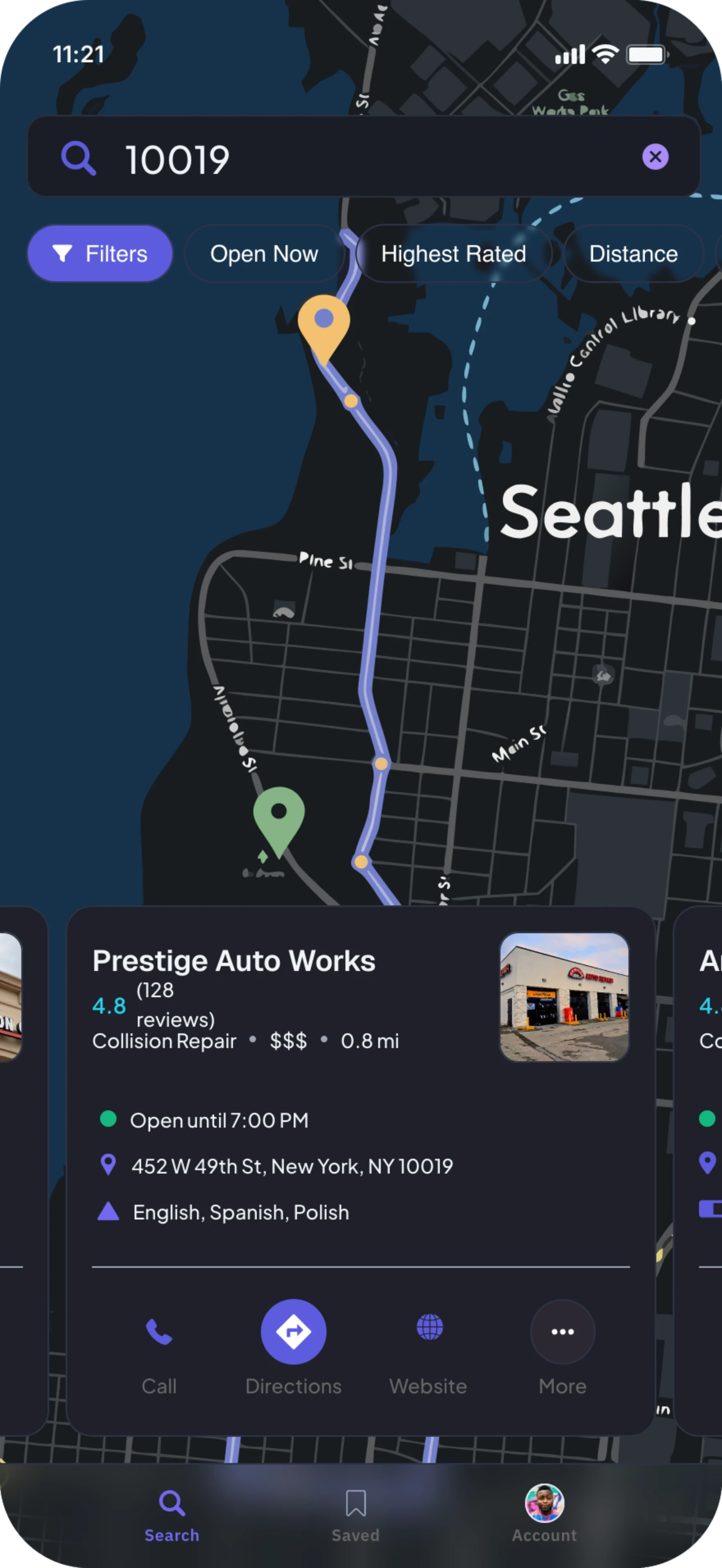
Alongside trust and fairness, participants also prioritized convenience when choosing a repair shop. Convenience meant more than location or business hours; it also included factors like language support and the availability of specific services. To make those considerations easier to evaluate, this information needed to be clearly surfaced in each listing’s About section and reflected in the search filters.
Visuals have been restyled for confidentiality. Functionality and user experience remain unchanged.
Visuals have been restyled for confidentiality. Functionality and user experience remain unchanged.
Visuals have been restyled for confidentiality. Functionality and user experience remain unchanged.
Visuals have been restyled for confidentiality. Functionality and user experience remain unchanged.
LISTING
DETAIL
Key Results
Exploratory research and concept work exposed a risk in the proposed mechanic finder before significant development began. A legal and business review determined that the insurer could not provide repair-shop information for non-claim work as envisioned. The organization made a no-go decision, avoiding further investment in a product it could not launch in that form. The project taught me to validate a product’s premise before refining its experience. The sponsor expected customers to trust recommendations from their insurer, but proxy research surfaced concerns about privacy and whether using a recommended shop might affect their rates. A proxy focus group could not stand in for direct customer research, yet it revealed assumptions worth testing. Early workflows and responsive wireframes also gave the Agile team enough clarity to estimate the concept before the no-go decision.
Key Results
Exploratory research and concept work exposed a risk in the proposed mechanic finder before significant development began. A legal and business review determined that the insurer could not provide repair-shop information for non-claim work as envisioned. The organization made a no-go decision, avoiding further investment in a product it could not launch in that form. The project taught me to validate a product’s premise before refining its experience. The sponsor expected customers to trust recommendations from their insurer, but proxy research surfaced concerns about privacy and whether using a recommended shop might affect their rates. A proxy focus group could not stand in for direct customer research, yet it revealed assumptions worth testing. Early workflows and responsive wireframes also gave the Agile team enough clarity to estimate the concept before the no-go decision.
Key Results
Exploratory research and concept work exposed a risk in the proposed mechanic finder before significant development began. A legal and business review determined that the insurer could not provide repair-shop information for non-claim work as envisioned. The organization made a no-go decision, avoiding further investment in a product it could not launch in that form. The project taught me to validate a product’s premise before refining its experience. The sponsor expected customers to trust recommendations from their insurer, but proxy research surfaced concerns about privacy and whether using a recommended shop might affect their rates. A proxy focus group could not stand in for direct customer research, yet it revealed assumptions worth testing. Early workflows and responsive wireframes also gave the Agile team enough clarity to estimate the concept before the no-go decision.